


Jaipur: A City Painted in Memory


There are places that exist as destinations, and there are places that exist as conversations. Jaipur is the latter. To visit it is not to simply see it is to be spoken to, to be questioned, to be remembered. The city lingers in the skin like the stain of henna, fading but never fully gone, carrying the fragrance of stories long after you’ve left its gates.
Jaipur does not rush you. It romances you. Every doorway feels like an opening into another century, every arch a threshold into a story you have not yet heard. The markets are not simply spaces of commerce—they are theaters where colors, sounds, and human voices weave themselves into choreography. And behind it all, the city blazes in pink.

Pink—the color of hospitality, the blush of welcome, the hue of celebration. It is said that the city was painted pink to welcome a prince in the nineteenth century. But over time, it became more than a gesture. It became the city’s own skin. Jaipur carries its history not only in monuments but in its very color, as though its walls were permanently caught in the warmth of sunset.
Jaipur is not just a city. It is memory made visible.
Stones do not forget. Colors do not fade without leaving echoes. Every wall is a page in a diary written by centuries of breath and dust.

To walk through Johari Bazaar is to step into rhythm disguised as chaos. The air smells of incense, of fried kachoris, of dust warmed by the afternoon sun. Vendors call out prices like refrains, their voices rising and falling with a music of their own. Bangles clink like cymbals, fabrics unfurl like painted scrolls, rickshaws weave between cows and children in a dance that seems haphazard but never collides.
What feels like disorder to the outsider is, in truth, choreography. Jaipur teaches you that chaos is often rhythm we have not yet learned to hear.
What is chaos, but rhythm beyond our understanding?

And then, the palaces. Jaipur does not keep its memory in books alone—it writes them in sandstone, marble, and mirror. The Hawa Mahal, delicate as lace, rises like a dream sculpted in air. Its countless windows once held hidden eyes—royal women who watched the life of the city without ever being seen. The Amber Fort glitters on the hillside, where the Sheesh Mahal holds entire galaxies in its mirrors, scattering candlelight into infinity.
These are not monuments. They are memory keepers. Every courtyard carries footsteps that no longer echo, every wall holds conversations now silenced by time. Kings and queens, poets and generals, servants and guards—all gone, and yet their presence clings to the stone.
Every palace is less stone than soul, less architecture than afterlife.

I thought then of the artisans. The nameless sculptors, masons, painters, and poets who
labored so these walls could stand. Their names are mostly forgotten, but their work remains as testimony. They did not build for recognition, but out of devotion to beauty itself. Perhaps they knew—as the temple builders of Belur and Halebid knew—that permanence is an illusion, but echoes endure.
The pink city is their echo. Each carved balcony, each patterned tile, each mirrored hall is a fragment of their unseen devotion. Jaipur is not only a monument to kings; it is a monument to the countless unnamed who gave their breath to eternity.
A hand shapes stone, and then disappears. But the stone remembers.

Beyond the gates, Jaipur reinvents itself. It does not cling to the past like a relic; it wears it like an ornament. Rooftop cafés serve coffee over block-printed tablecloths. Electronic beats mingle with temple bells. Ancient weaves are reborn in modern boutiques. Jaipur refuses to separate tradition from modernity. It lets them walk together, as queen and consort, inseparable.
The city whispers that the past and the future are not enemies—they are partners in an eternal dance. Change does not erase memory; it carries it forward, reshaped, re-sung, reborn.
Tradition and change—not opposites, but two hands clasped in the same dance.
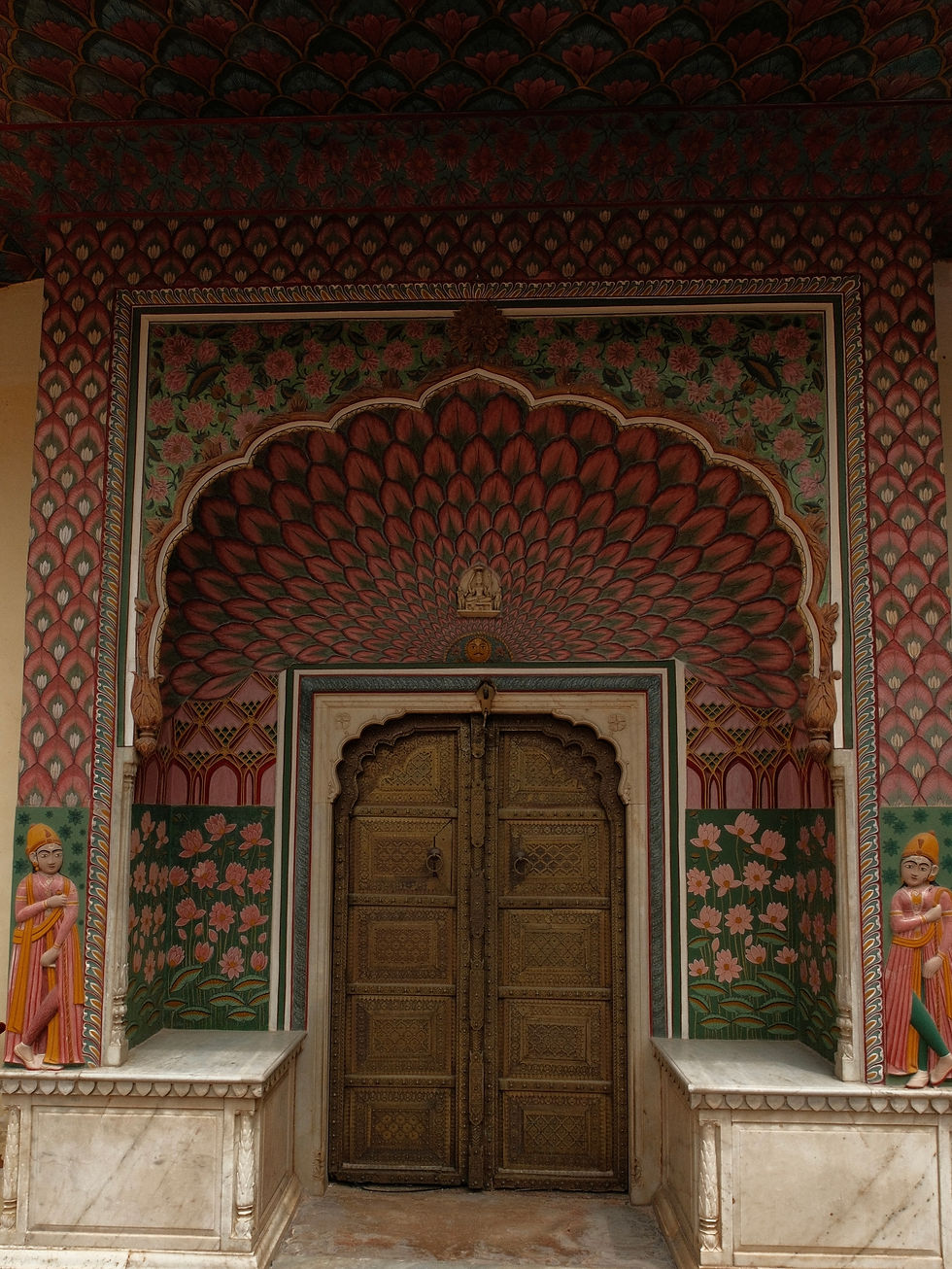
And then there are the sunsets. In Jaipur, the sun does not simply disappear—it lingers, folding itself into the Aravalli hills like a letter being sealed. The streets glow under fairy lights. Rooftops hum with quiet conversations over steaming cups of chai. Laughter mingles with prayer, the everyday merging with the eternal.
There are sunsets you watch, and there are sunsets that watch you back. Jaipur’s belong to the latter. They gaze into you, reminding you that you too are part of this vast choreography of time—that just as you walk through Jaipur, Jaipur also walks through you.
The sun sets, but does not vanish. It lingers in walls, in voices, in you.

Jaipur is not a destination. It is a conversation—between kings and travelers, between stones and skies, between memory and tomorrow. To leave Jaipur is not to finish it, but to carry it. It presses itself into your palm like a secret, a story that continues to unfold long after you have left.
Some cities are made of concrete. Jaipur is made of stories.
✨ Closing mantra: “Nothing remains, and yet, everything echoes.”


Comments