


The Eternal Whisper of Marble: Reflections on the Taj Mahal
- Aditya Hegde
- Sep 15, 2025
- 4 min read


The first glimpse of the Taj Mahal does not arrive with surprise—it arrives with inevitability. We have all seen its image countless times in books, postcards, and photographs. And yet, when I stood before it in person, I understood why no image can ever contain its truth. The Taj is not just seen; it is felt. It does not rise from the earth like a monument—it breathes like a memory too heavy to fade.
They call it a tomb, but it is more than a resting place. It is a paradox carved in white marble: a mausoleum that celebrates life, a symbol of love born from heartbreak, an architecture of permanence standing upon the foundations of impermanence.
What greater devotion exists than to turn heartbreak into eternity? What greater cruelty exists than eternity built upon heartbreak?

The story is known, yet it never loses its weight. Shah Jahan built the Taj Mahal in memory of Mumtaz Mahal, his beloved queen, who died in childbirth in 1631. In her absence, he envisioned a structure so perfect, so timeless, that it would embody their love and outlast the centuries.
It took twenty-two years to complete, with over twenty thousand artisans and laborers
shaping it day after day. Some worked in marble quarries far away in Makrana, others inlaying the delicate flowers of semi-precious stones—lapis lazuli, jasper, carnelian, jade—into white marble walls. Calligraphers inscribed verses from the Qur’an in flowing black script that still reads as clearly as the day it was carved. Masons raised domes, minarets, and arches with such precision that the entire structure is perfectly symmetrical, down to the placement of its gardens and reflecting pools.
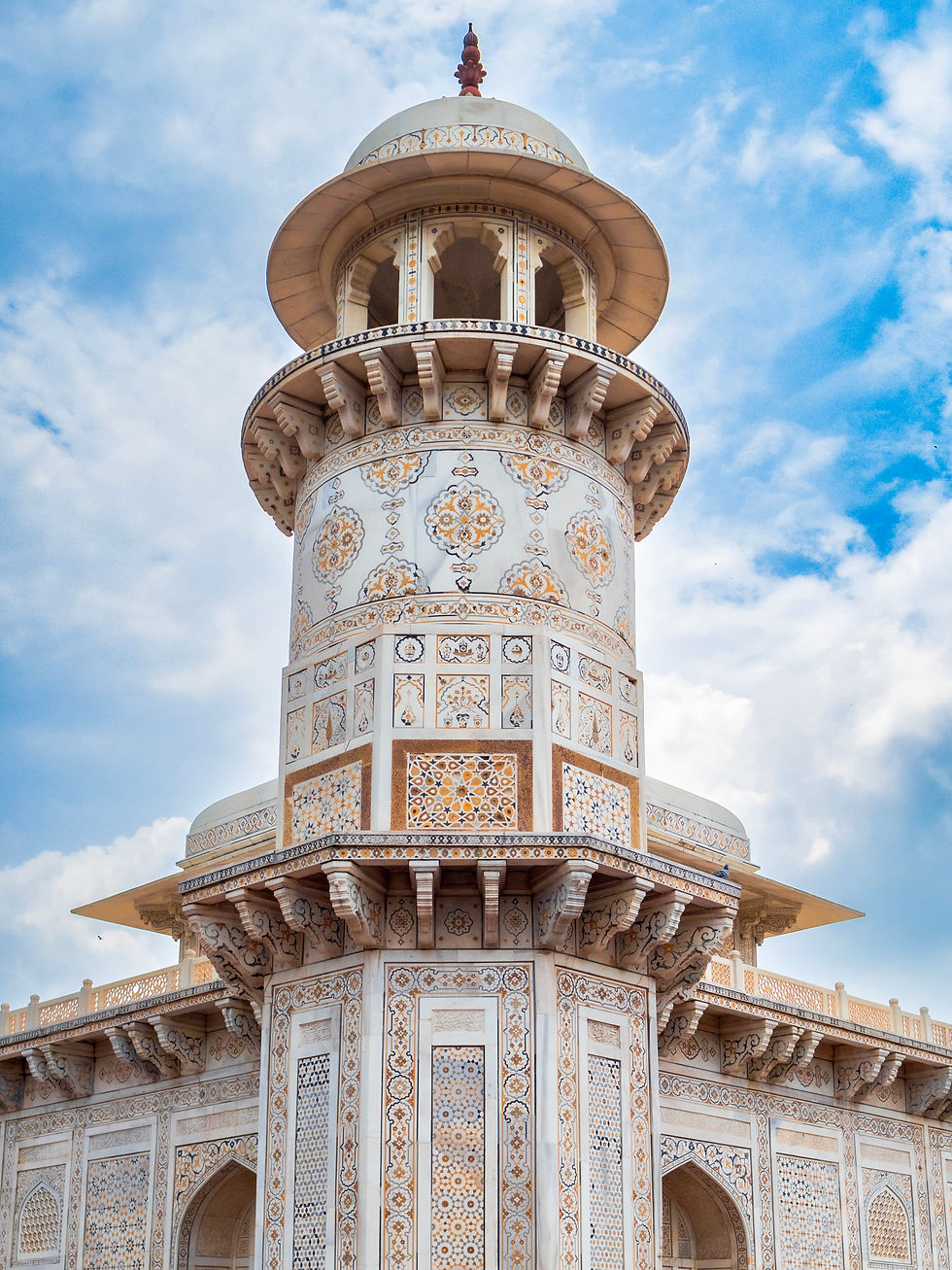
When I thought of this—the decades of labour, the thousands of hands, the lives devoted entirely to a vision not their own—I realised that the Taj Mahal is as much theirs as it is Shah Jahan’s. He may have dreamt it, but they are the ones who carved eternity from stone.
A hand strikes marble, again, again, again. A thousand hands, a thousand lives—each leaving behind a silent prayer within the stone.
But history alone does not tell the whole story. The Taj Mahal is surrounded by lore, and sometimes it is the legends that carry the deepest truths.
One tale speaks of Shah Jahan’s unfulfilled dream of building a second mausoleum—this time in black marble—across the Yamuna river, a dark twin to the Taj, meant to hold his own body. Between the two, a bridge of silver was to connect him eternally with Mumtaz.

Whether true or not, the story lingers because it reflects something universal: our longing for symmetry, for unity in life and death, for love to remain whole even when torn apart.
Another legend whispers of the artisans themselves. It is said that Shah Jahan ordered their hands to be cut off, or their eyes blinded, so that no other monument could rival the Taj.
Historians doubt this story, but myths often outlive facts because they reveal a deeper wound: the cost of beauty, the shadow of suffering that lies behind creation. Every masterpiece carries invisible sacrifices—whether or not this legend is true, the labour of the nameless artisans remains etched in silence.
Marble does not speak, yet it carries more stories than words ever could.

As I stood in its courtyard, watching the Taj shift colours with the passing light—rosy at dawn, golden at dusk, silver beneath the moon—I realised it is not a monument to love alone. It is a meditation on time. The love story that inspired it has long passed; the lovers themselves reduced to dust within its walls. The artisans who carved it are gone. Empires have risen and fallen around it. And yet, the Taj endures—unchanged, still breathing, still whispering.
Shah Jahan himself would never walk its gardens again after being imprisoned by his son Aurangzeb. From the red sandstone walls of Agra Fort, he gazed at the Taj in the distance until his death. Perhaps, for him, it was both solace and torment: the monument to his beloved always in sight, but never again within reach.
And this, too, feels deeply human. We build to resist time, even as time imprisons us. We pour love into forms that will one day fade, yet in the act of creating, something transcends.

Even eternity fades, but the echo lingers.
The Taj Mahal is not only a story of love—it is a story of time, of labour, of devotion, of impermanence made beautiful. The lovers it enshrines have long turned to dust. The artisans are gone. The empire that built it no longer exists. And yet, the marble breathes on, whispering their echoes.
Perhaps this is the true lesson of the Taj: nothing we love can last forever, but in loving deeply, in creating out of that love, we leave behind something that resonates beyond us. The Taj is not just Shah Jahan’s grief—it is a reminder of every human longing to resist time. To carve permanence out of impermanence. To turn heartbreak into beauty. To leave behind an echo.
And maybe that is what eternity truly is: not in marble, not in stone, but in the echoes we carve into the world.


Comments